Practical gear worth a look — tools, fencing, livestock, truck & trailer, and shop staples.
As an Amazon Associate, we earn from qualifying purchases. We may earn a commission when you buy through links on this site.
Portable generator buying guide for farm and shop
Last reviewed October 27, 2026. Sources are listed at the bottom of the page.
A portable generator is only a good buy if it is big enough for what you plan to run and you can run it safely. This guide covers how to size one, what to check on the listing, and the safety rules published by the U.S. Consumer Product Safety Commission (CPSC). Every fact below has a numbered source at the bottom of the page.
Step 1: Add up what you want to run
Generator sizing uses two numbers. Running (or rated) watts are the continuous watts needed to keep items running. Starting watts are extra watts needed for two to three seconds to start motor-driven items such as a refrigerator or a circular saw.[1]
Briggs & Stratton lays out the steps like this:[1]
List the items you want to power at the same time.
Find each item's running watts and additional starting watts in its manual or on its data plate.
Add the running watts of everything on the list. The generator needs to produce at least that many running watts.
Pick the one item with the most additional starting watts and add that single number to the running total. The result is the starting watts the generator needs.
If an item doesn't list its watts, one generator seller's sizing guide says to multiply the amps by the volts shown on the nameplate.[2] The same guide suggests adding 25% to your total so the generator isn't running at its maximum.[2]
A worked example from Lowe's
Lowe's published a wattage worksheet with this example.[3] The numbers are approximate, and Lowe's says to check your own appliance for its actual requirements.[3]
The running watts add up to 3,950. The largest additional starting figure is the belt sander's 2,400, so the example needs at least 3,950 running watts and 6,350 starting watts.[3] Use the numbers from your own tools and appliances, not these.
Step 2: Check the listing
Run time at half load. Briggs & Stratton says to look for a long run time at half load, and that 10 hours or more at half load lets you sleep through a night without getting up to refuel.[1]
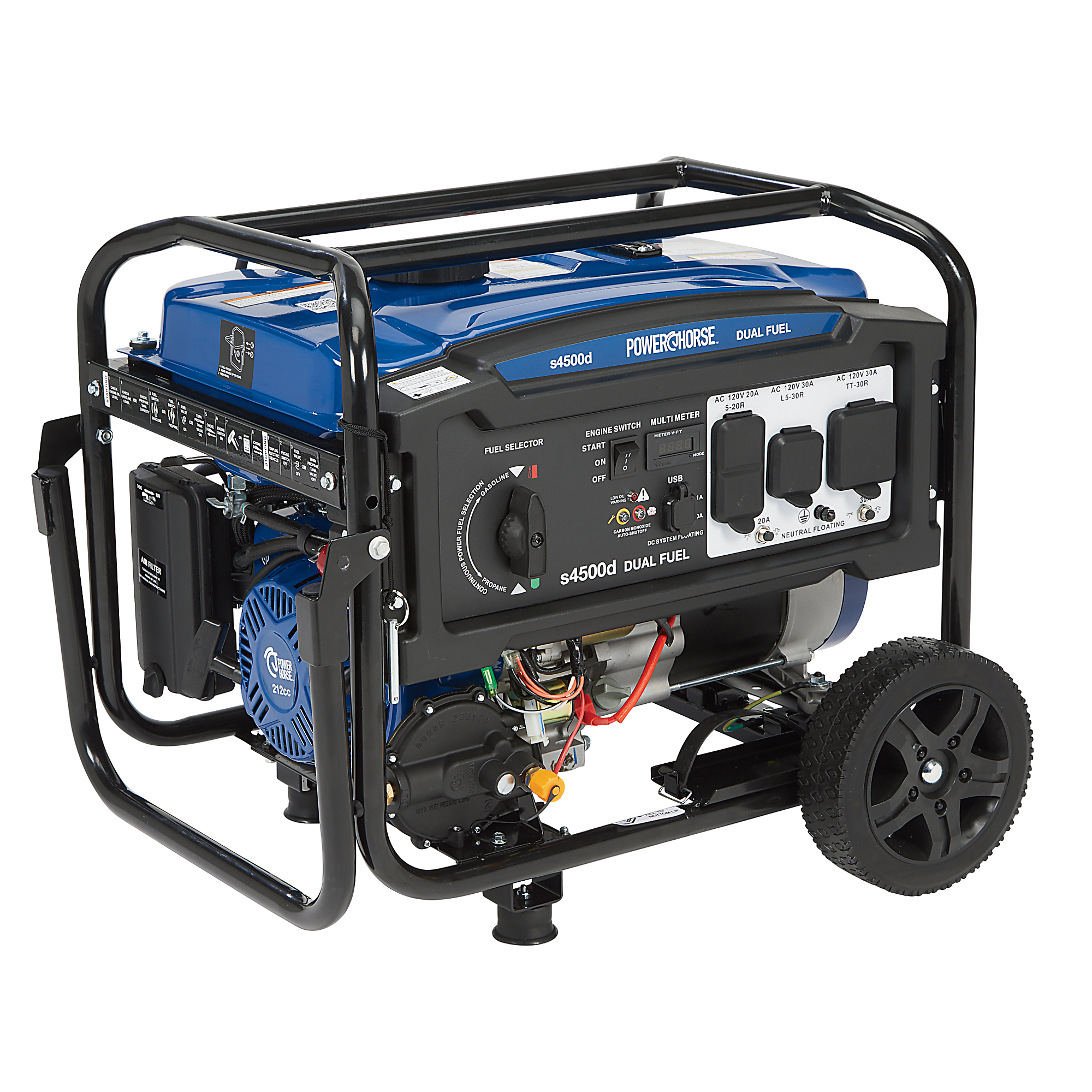
Outlets. Make sure the generator has enough outlets of the right types. Briggs & Stratton says to look for a 30-amp locking outlet if you plan to run a higher-wattage item such as a window air conditioner.[1]
Carbon monoxide shut-off. CPSC says to ask retailers for a portable generator with a safety feature that shuts it off automatically when high carbon monoxide (CO) levels are present, and notes that some models with CO shut-off also have reduced emissions.[4]
Fuel and electric start. The product page spells out which fuels the model runs on and how it starts. Check that against what you have on hand.
Run a portable generator outside only, at least 20 feet away from the house, with the exhaust directed away from the home and other buildings.
Never run one inside a home, garage, basement, crawlspace, shed or on a porch, and keep it away from doors, windows and vents.
Install battery-operated CO alarms, or CO alarms with battery backup, outside sleeping areas and on each floor of the home, and test them monthly.
Know the symptoms of CO poisoning: headache, dizziness, weakness, nausea, vomiting, sleepiness and confusion. If you suspect it, get outside right away and call 911.
Read and follow the labels, instructions and warnings on the generator and in the owner's manual, and keep the generator properly maintained.
CPSC describes generator exhaust as containing carbon monoxide, a poison you cannot see or smell.[5]
Generator deals on the board right now
These are the sale prices we checked on each retailer's page when the board was last updated (Nov 11, 2026, 5:32 AM ET). Prices change quickly, so confirm the price in the retailer's cart.